About
Poxy consists of a small library and a few command-line routines, intended to help with the technicalities of performing classical molecular dynamics (MD) simulations of oxidation of silicon nanostructres, e.g. Si nanowires (SiNW), Si films/membranes or Si nanoclusters (SiNC).
Poxy serves the apparently simple tasks to:
- Read an input Si or SiO_2 structure, incorporate an oxygen atom (or many O atoms) and write out the resulting structure.
- Convert and visualize between few different formats related to input/output of MD simulations.
- Iterate over 1, until given number of O atoms is incorporated.
Note that the MD simulator is an external engine, and only LAMMPS is currently supported (a limitation owing to point 2 above).
Poxy assumes the use of non-reactive force-field – e.g. the Tersoff potential with Munetoh‘s parameterization or the Stillinger-Weber potential as extended by Watanabe, suitable for the Si/SiO2 system as occurring in thermal oxidation of Si.
Two approaches to consider are:
- Make bulk amorphous SiO2 structure, cut-out the desired core-shape, replace with crystalline Si, anneal to cure the interface [Illinov].
- Take a crystalline Si structure, incorporating O in the middle of the Si-Si bonds at the interface, repeat until SiO2 of desired thickness forms [Watanabe, Munetoh].
Poxy currently focuses on the second approach. The details of O incorporation are described in Ganster and Torre, and the concept is illustrated in the two figures below. It models the reaction of O with Si only, ignoring aspects of O transport to the interface.
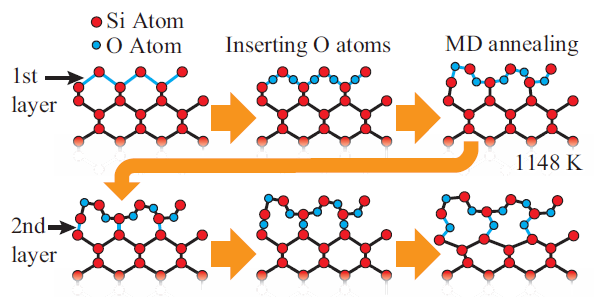
Oxidation flow by consecutive addition of O between the Si-Si bonds at the interface, leading to layer-by-layer oxidation [Mori].
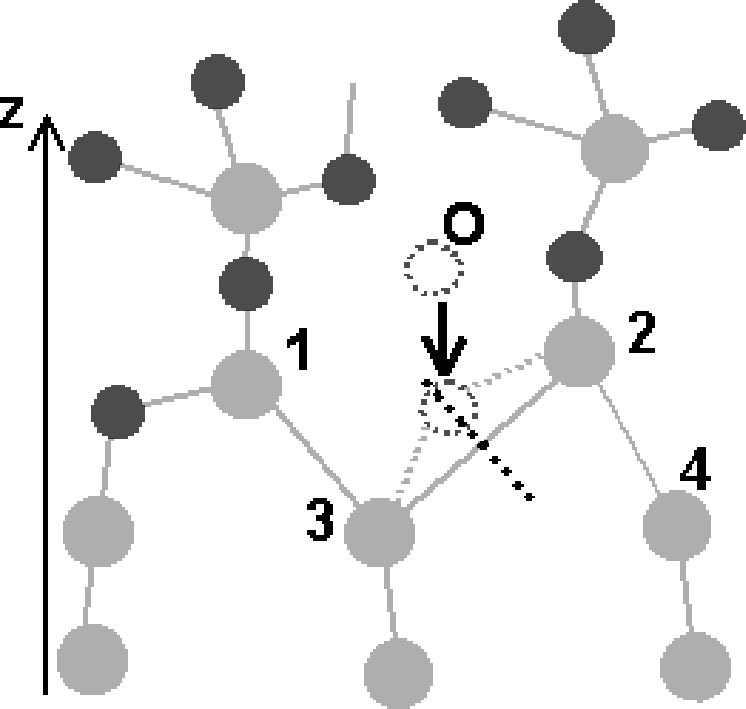
Selection of position for O incorporation, setting the nominal 1.6 A Si-O distance before the anneal [Torre].
Poxy reflects the learning effort of the author (S.Markov) in this field with the aim to produce Si nanostructures with native oxide, suitable to study electron and phonon transport, carrier dynamics due to light excitation etc., in such nanostructures. It was jump-started by the kind donation of some prior code by Dr. Alessandro Pecchia (Univ. Torr Vergata, Roma, Italy).