Tutorial
We start with the creation of a pristine [110]-SiNW with 15 A diameter and about 8 A long - this is the minimal possible length along this direction. Below, we add 30 A vacuum buffer to the simulation box. As an example, the lattice constant of Si is modified to 5.45 A, to reflect the relatively high temperature that will be used during oxidation (1200 K).
poxy create -s wire -o 110 -d 15 -l 8 -vac 30 -aSi 5.45 -f nw_110_D15_L8.gen
poxy_view "-r 90y" '-c {"Si":1.385}' nw_110_D15_L8.gen
The structure, of 68 Si atoms, is shown below.
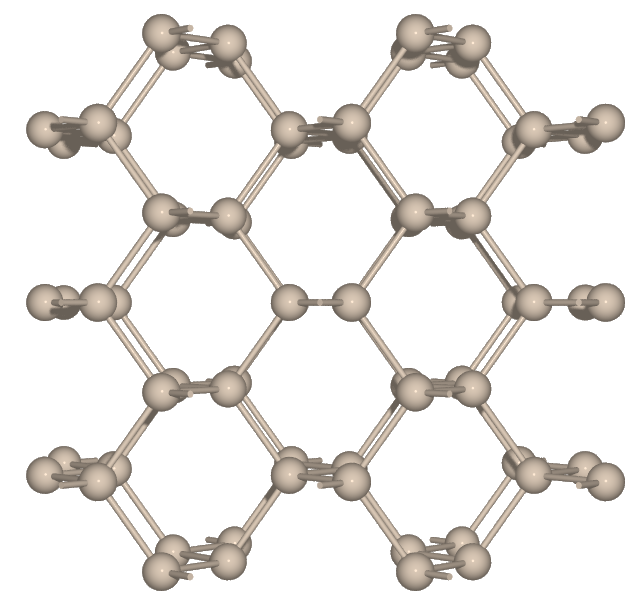
Pristine SiNW (segment) as created.
We are going to heat the structure by MD to the annealing temperature of the oxide, say 1200 K, and start adding oxygen atoms.
Before doing that we should organise things a bit – the addition of an O atom will yield 4 files: a log file with thermodynamic info from MD (.log), a dump file with geometry snapshots at different times (.dump), as well as a structure file (.gen) and a corresponding image (.png) of the equilibrated structure after the addition of an O atom. The log and dump files go to output directory, the structure and image go to structures directory.
mkdir output structures
/bin/mv nw_110_D15_L8.* structures/
Note
The two scripts used in this tutorial: prepare.sh and oxidise.sh
both assume certain invokation of LAMMPS. The assumption is
encoded in the following variable: mdcmd='mpirun -n 4 lmp_g++',
which should be modified as per your case.
To heat the structure to the annealing temperature, we run MD with
the help of a very short script (prepare.sh):
It requires that the input structure is pristine.gen, hence:
cp structures/nw_110_D15_L8.gen structures/pristine.gen
./prepare.sh
At this stage, we have heat.dump in output and heat.png shown below, and we can start incorporating oxygen.
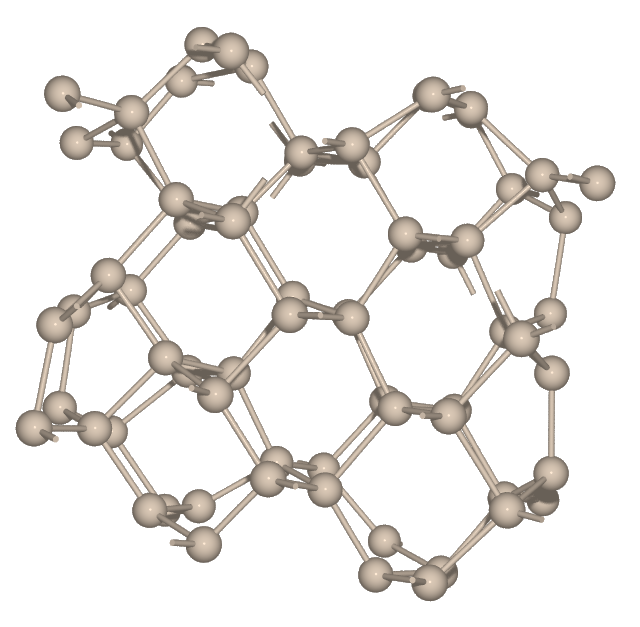
Geometry snapshot at 1200K (structures/heat.gen)
To oxidise this NW, we try to incorporate e.g. an equivalent number of atoms,
e.g. 68. The script (oxidise.sh) is invoked
as follows and runs for short-while (~5min on 4-core dell optiplex).
./oxidise.sh output/heat.dump 68 either 2>&1 | tee oxidise.log
Other than the results in structures, the script automatically combines the images into a video (oxidation.mp4), shown below.
Note
The prepare.sh and
oxidise.sh assume LAMMPS as an MD
enjine. Therefore, the corresponding input files must be present
in the project directory. These are:
md.heat.in, and
md.equilibrate.in.
The details pertaining to the MD are beyond the skope of this
tutorial.
The final structure is not ready for electronic structure calculations. It must be further relaxed and minimised. Probably it will produce gap-states too. The further relaxation, minimisation and eventual passivation of defects is outside the scope of POXY. Note however, that certain parameters of md.equilibrate.in may largely affect the final result. Their optimisation is on-going.